
Checklists and audits: how it works
A checklist is an audit template: sections, questions and scoring rules. An audit is one run of a checklist at a specific location by a specific employee. The administrator creates checklists in the web dashboard, auditors carry out audits in the mobile app, and the results are collected into reports and analytics.
What a checklist is made of
- Sections — groups of questions, for example "Dining room", "Kitchen", "Storage". The report calculates a separate score for each section.
- Questions — audit items. The question type is Yes / No (scored) or Text field (free-form answer, not scored).
- Question weight — how many points an item is worth. Used if the checklist's scoring method is In points.
- Settings — who can use the checklist, when it can be completed, scoring method, folder, signature, geolocation and AI review.
How to fill all this in is explained in How to create a checklist.
The audit path: from template to report
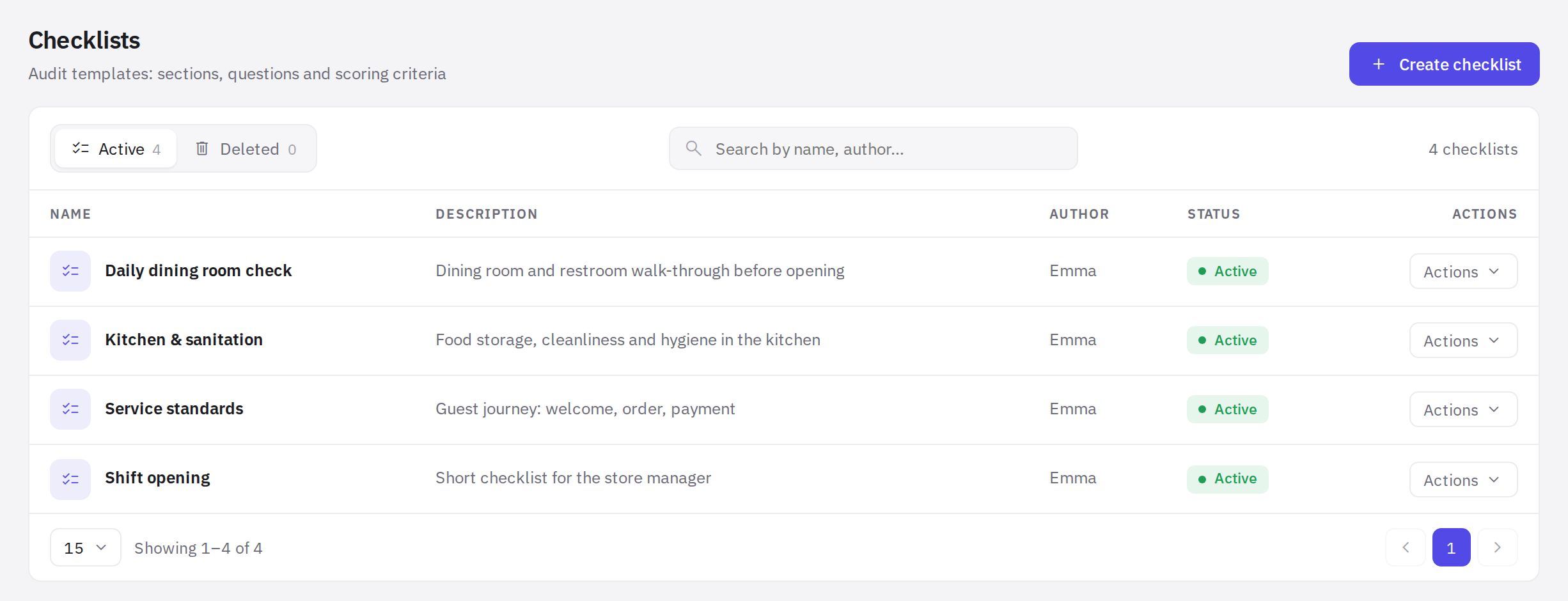
- Create a checklist. In the Work → Checklists menu, click Create checklist and fill in the builder.
- Decide who audits and when. Limit access to the checklist to specific employees, or schedule regular audits in the Planner.
- The auditor carries out the audit in the app. They choose a location and a checklist, answer the questions, attach photos and submit the audit.
- jeCheck calculates the score and builds the report. The audit report opens by link and can be downloaded as a PDF.
- The report is sent by email. The auditor and employees on this checklist's mailing lists receive it.
- Violations become tasks. If an automation scenario is set up, "No" answers create tasks — see Automation.
- Results flow into analytics. See trends by location, question and auditor in Analytics.
Where audits are carried out
Regular audits are carried out only in the jeCheck mobile app — you can't complete a checklist in the web dashboard. Step-by-step instructions for auditors are in How to carry out an audit in the mobile app.
What the auditor sees in the app:
- checklists they have access to (the Who can use the checklist setting; if no one is selected, the checklist is available to everyone);
- locations they are assigned to; if they aren't assigned to any location, all of the company's locations;
- audits scheduled for today from the Planner.
The exception is mystery shopper audits: the shopper fills in the form via a link in the browser, without the app. Learn more in Mystery shopper.
Where to find things in the dashboard
- Work → Checklists — the checklist list and builder. Available to administrators only.
- Work → Audits — a summary of completed audits by location and checklist for selected dates, with Excel export.
- Analytics → Audit log — every audit individually: reports, PDFs, exports. See Audit log.
- Management → Mailing lists — who receives reports by email.
- Work → Planner — the schedule of planned audits.
Frequently asked questions
Can I carry out an audit from a computer?
No. A regular audit is carried out in the mobile app. The only thing filled in from a computer is the mystery shopper form — it opens by link.
What happens if I delete a checklist?
It moves to the Deleted tab on the Work → Checklists page and disappears from the app and the Planner. Checklists deleted in the last 90 days can be brought back: Actions → Restore.
Who can create and edit checklists?
Only company administrators. The Checklists section isn't available to other employees.
How does an audit result become a percentage?
It's the share of "Yes" answers among items answered "Yes" or "No" — or the share of points earned if the checklist is scored in points. Details are in How the audit score is calculated.
Thank you! This helps us improve the help center.