
Roles and permissions — administrator, positions, managers
Permissions in jeCheck come from several settings: the user type, the position, the manager role at a location, and separate flags such as Test editor. Below is what each of them gives and where it is set.
Administrator and user
The type is chosen in the employee card in Management → Users (the User type field).
- Administrator — access to all sections and settings and to all company locations. Only administrators can open Users, Locations, Checklists, Automation, Mystery shopper and Mailing lists and change the organization Settings (others can only view them). An administrator can always sign in to the web dashboard.
- User — a regular employee. In analytics they see only the locations they are linked to. Administrator-only sections don't open for them — they get a message saying they lack permissions.
Whoever registered the company becomes an administrator automatically.
Make administrators only of the people who actually configure the company. Location managers usually need just the User type with the Manager mark at their location.
Positions
A position (role) is the employee's job: “Chef”, “Barista”, “Manager”. An employee has one position, shared across all locations.
Positions are used by:
- automation — in a checklist, a role is assigned to a section or question, and the scenario sends the violation task to the employee with that role at the audited location;
- testing — tests are assigned by position;
- instructions — instructions are addressed to positions.
How to create and edit positions
-
Open the list. Management → Users, Positions tab. The number of positions is shown next to the tab name.
-
Add a position. Type a name in the New position field and click Add.
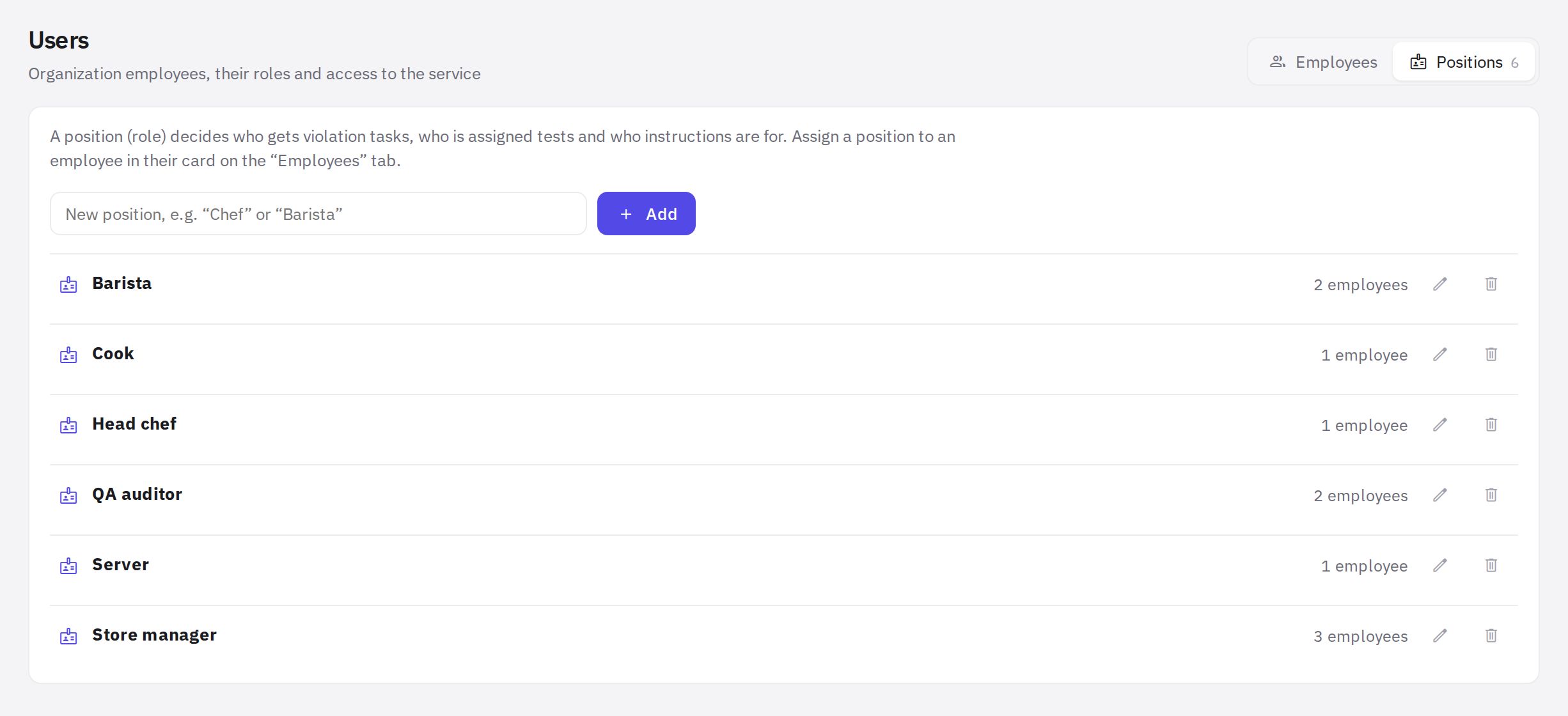
The Positions tab: add, rename and delete -
Rename or delete. Each position has Rename and Delete buttons. Next to the name you can see how many employees hold it.
You can assign a position to an employee in their card (the Position field) or on the Locations and teams tab (the Role column). You can also add a new role there, in the Roles block, but you can rename or delete it only on the Positions tab.
When you delete a position, employees who held it are left without one, and violation tasks for that role start going to location managers.
Location manager
A manager is marked with a tick in the Manager column on the Locations and teams tab — separately for each location. Managers review task completion and receive overdue alerts and tasks for which no employee with the required role was found at the location. If a location has no manager, these tasks go to administrators.
How to set it up — /docs/team/locations.
Test editor
The Test editor checkbox in the employee card lets them create tests, assign them and view results without being an administrator. More about tests — /docs/testing.
HACCP manager
The HACCP module has its own role — HACCP managers. They manage the plan, logs and directories and close critical deviations. Administrators are always HACCP managers. They are assigned in the HACCP module settings — see /docs/haccp.
How employees see their role
An employee's Profile has a Role and locations card: access type (administrator or employee), position and the locations where they work, marked “manager” where applicable. Only an administrator can change them.
Frequently asked questions
Can an employee have two positions?
No, an employee has one position. If someone combines duties, create a position that reflects this or choose the main one.
Can I close the web dashboard for an administrator?
No. Administrators and the company creator can always sign in to the web dashboard. See /docs/team/web-access.
Thank you! This helps us improve the help center.